
Solving Driveway Drainage: Channel Drains, French Drains & Regrading
Prevent water pooling near your garage or foundation with heavy-duty slotted channel drains and proper sub-base grading.
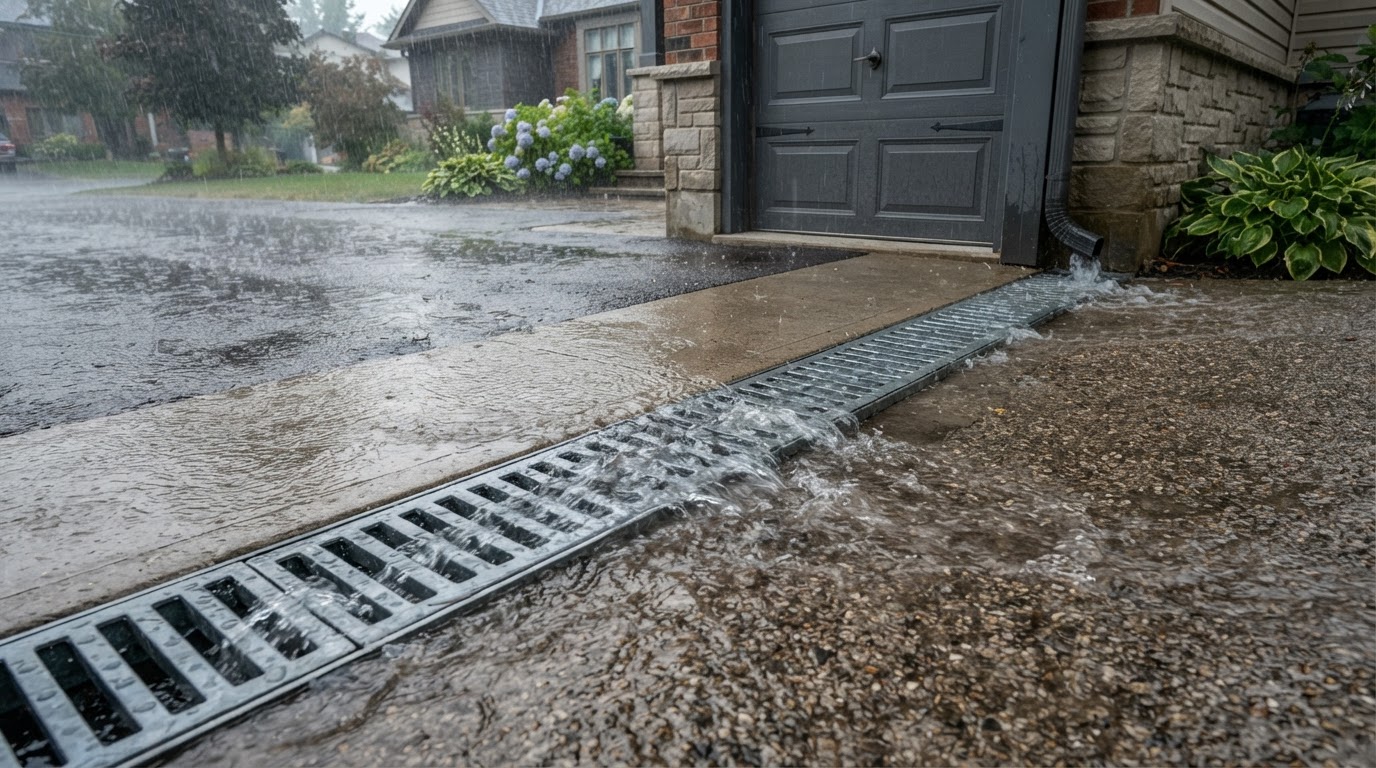
Installing heavy-duty slotted trench drains across garage thresholds diverts rainwater away from structures before resurfacing begins. Water is the most destructive force a driveway faces, and poor drainage is the root cause of most premature pavement failure. When water pools on the surface, runs toward the garage or foundation, or saturates the sub-base, it undermines the structural integrity of the entire driveway system. Solving drainage before any resurfacing or overlay work is not optional—it is the prerequisite for a durable result.
The first diagnostic step is to observe the driveway during and after a heavy rain. Where does water pool? Does it sheet toward the garage door, the foundation, or a landscape area? Does it disappear slowly, indicating a low spot or a clogged existing drain? A properly graded driveway should slope away from the garage and foundation at roughly 1% to 2% (about 1/8 to 1/4 inch per foot) and direct water to a safe discharge point—typically the street, a swale, or a dedicated drain. If the slope is wrong or reversed, no surface treatment will prevent water problems.
Channel drains, also called trench or linear drains, are the most effective solution for water that sheets across a wide area, such as the base of a sloped driveway where it meets a garage or sidewalk. A channel drain is a long, narrow grate set flush with the driveway surface, with a trough beneath that collects water and pipes it away. Installed across the full width of the driveway at the low point or the garage threshold, a channel drain intercepts the runoff before it can enter the garage or pool against the foundation. Heavy-duty polymer concrete or metal channels with load-rated grates are essential for driveways that bear vehicle weight.
French drains address a different problem: subsurface water. If the soil alongside the driveway is saturated, or if a high water table or a hillside is pushing water under the pavement, a French drain—a perforated pipe in a gravel-filled trench—intercepts that groundwater and carries it away before it reaches the sub-base. French drains are typically installed along the edge of the driveway, just outside the pavement, and discharge to a lower elevation or a dry well. They are invisible once installed but critical in properties with heavy runoff or poor natural drainage.
Regrading is sometimes the only real fix. If the driveway was built with insufficient slope, a reverse slope toward the garage, or a low spot that collects water, no drain can fully compensate. Regrading involves re-establishing the correct crown and slope, which may require milling the existing surface, adjusting the base, and re-paving. This is more invasive and expensive than adding a drain, but it addresses the root cause rather than the symptom. A contractor with grading experience can determine whether a drain is sufficient or whether regrading is necessary.
Sub-base restoration goes hand in hand with drainage. The aggregate base beneath the asphalt or concrete is what carries the load; the surface layer merely protects the base and provides a wearing course. If water has saturated and weakened the base—often indicated by alligator cracking, rutting, or settlement—the base must be excavated, recompacted with the correct aggregate, and re-graded before any new surface is installed. Installing an overlay over a saturated, failed base guarantees the new surface will fail in the same pattern as the old one.
The connection between drainage and resurfacing cannot be overstated. A homeowner who resurfaces a driveway without fixing the underlying drainage problem is wasting money—the new surface will develop the same cracks, the same pooling, and the same failure as the old one, often within a single season. The correct sequence is: diagnose the drainage, install drains or regrade as needed, restore the sub-base if it is compromised, and only then apply the overlay, resurfacing, or sealcoat. This order ensures the investment in the new surface is protected by a sound, dry foundation.
For homeowners, the practical advice is to hire a contractor who evaluates drainage as part of any resurfacing quote. A contractor who only quotes a surface treatment without discussing slope, water flow, and existing drainage is missing the most important factor in driveway longevity. The right combination of channel drains, French drains, regrading, and sub-base restoration—matched to the specific water problems on the property—will protect the driveway, the garage, and the foundation, and ensure that any resurfacing investment delivers its full expected lifespan.
Looking for a qualified contractor? Browse our directory of driveway resurfacing professionals specializing in drainage & driveway sub-base restoration. Compare services, request quotes, and find the right specialist for your project.
 Advertisement
Explore Drainage & Driveway Sub-Base Restoration
French drain installation, channel drains, and aggregate base stabilization.
Browse Drainage & Driveway Sub-Base Restoration